
Deep Reads: Liminality
Liminality is the time and place where the thing that was a caterpillar, and will soon become a butterfly, is for some time just a soupy goop.

These Deep Reads have been on a bit of a hiatus. Other projects have needed my focus and steeping—among them, an entirely new, hand-drawn deck that has been taking slowly form. More on that in the coming months.
But here we are, in what are arguably some of the most liminal days of our collective calendar. Those between December 25 and December 31. So what better a time to visit the liminal than from within it?
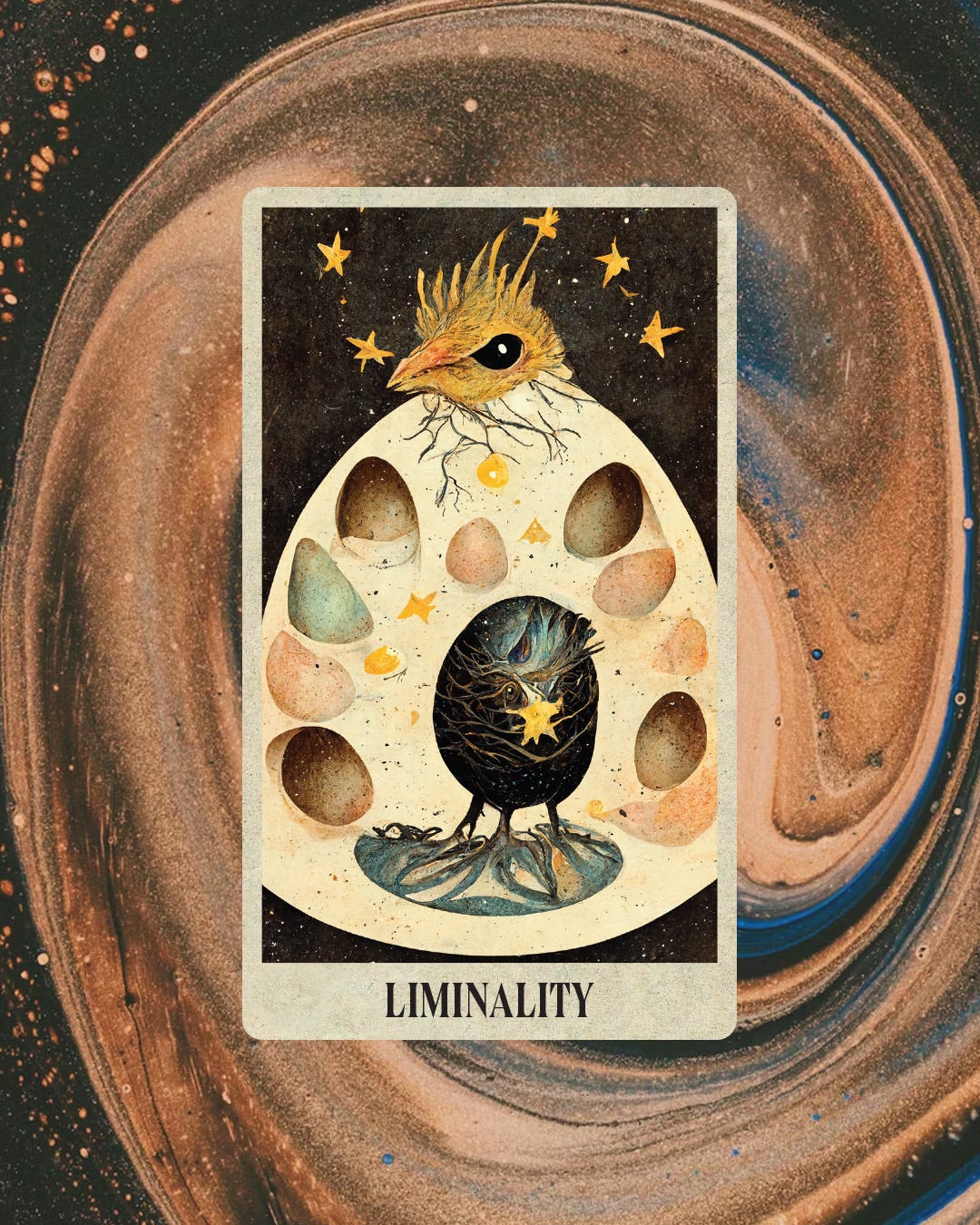
With all the specific “Valleys” and goings-on in this deck, Liminality acts as a counterweight. A non-place. The image shows a egg within an egg. The inner-most egg buds a star, reflecting the night-sky from which this scene emerges.
My first understanding of the term came from Victor Turner and his work with rites of passage. Rites of passage, which we are generally devoid of in modern western culture, are markers in our lives that usher us from one way of being–one identity–to another. And they generally have 3 parts: A departure, a liminal state, and a return and integration.
Liminality is the time and place where the thing that was a caterpillar, and will soon become a butterfly, is for some time just a soupy goop. It’s the deep woods. The back of the cave. The silence that shatters, making way for the new. During the liminal period, participants may be masked, renamed, or led to a symbolic, mock-death. As temporary residents of this “other world”, the liminal person, or initiate, is both vulnerable and powerful; dangerous and sacred. And that power comes precisely because they are, for the time, unclassifiable.
The place of liminality is not mean tot be well understood. In fact, I think it is our duty to protect its mysteries. It is good to know things. But knowing is not the place where the water washes over you. Liminality is a protected place of suspended social order, where something new can emerge.
This card appears when you are no longer who you were, but not yet who you are becoming. The old identity has lost its authority. You may be tempted to rush forward toward clarity, or answers, or something that feels like ground. But liminality does not respond to force. It responds to presence. Let the New Years resolutions come soon. But this here is not the time for public declarations or permanent commitments. It is a time for listening, observing, and tending to what is quietly reorganizing beneath the surface.